


 Golam Rabiul Alam, PhD
Understanding the USPTO AI patent eligibility guidelines is now critical for software engineers, as many technical founders incorrectly assume AI algorithms are fundamentally unpatentable under Section 101. While algorithms themselves remain non-patentable, our 2026 legal audit confirms a clear pathway: AI-driven systems are eligible for protection if integrated as technical improvements to machine functionality—rather than claiming the underlying mathematics. Here is the exact architectural framework required to bypass Section 101 rejections and pass the USPTO Alice test.
At A Glance
To patent AI algorithms under Section 101, applicants must demonstrate a specific “technical improvement” to computer functionality (e.g., faster processing or reduced memory usage) rather than claiming the algorithm as a standalone mathematical model. The USPTO requires a “practical application” that integrates the AI into a real-world system to overcome the “abstract idea” exception of the Alice test.
The Short Answer
Yes, you can patent an algorithm, provided it is not just an abstract mathematical formula. To be patentable under current USPTO rules, the algorithm must be applied to solve a specific technical problem or improve a computer’s functionality. It must produce a “tangible result”.
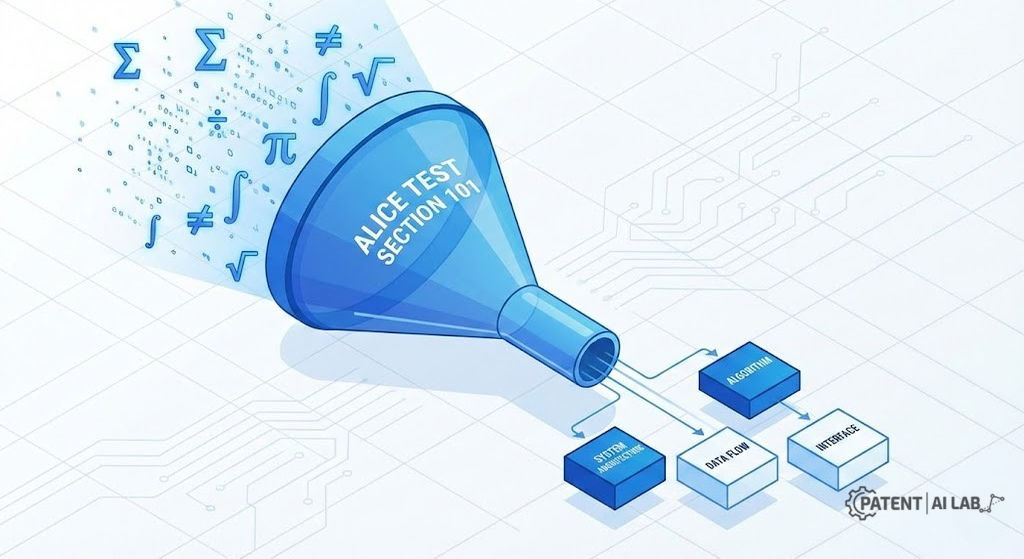
We built this analysis on a brutal reality check: examining current USPTO guidance, Federal Circuit shifts, and actual AI patent prosecution outcomes through 2026.
Let’s be direct. If your application is poorly drafted, a Section 101 rejection is structurally guaranteed. Why? Because most founders mistakenly pitch abstract math instead of a patentable invention. Patent examiners are legally forced to reject applications unless you anchor the algorithm to a measurable, system-level technical improvement.
When interpreting the current USPTO AI Patent Eligibility Guidelines, success hinges on how you position your core architecture. This article cuts through the fluff, detailing exactly how examiner frameworks operate, how to architect your claims under Section 101, and the precise steps to survive Alice Step 2 scrutiny.
What Section 101 Actually Says
The statutory framework establishes the boundaries of patent eligibility while enforcing specific judicial exclusions.
Statutory Categories
Section 101 defines what can be patented. It allows patents for:
- Processes
- Machines
- Manufactures
- Compositions of matter
Judicial Exceptions
However, it explicitly excludes three judicial exceptions:
- Abstract ideas
- Laws of nature
- Natural phenomena
From the USPTO’s perspective, many AI claims structurally resemble standard exceptions:
That puts them directly in Alice territory.
When applying the current USPTO AI Patent Eligibility Guidelines, it is critical to focus on system-level performance improvements rather than the underlying mathematical logic.
The Alice Test Explained for AI Patents
Every Section 101 analysis follows the Alice/Mayo framework.
Is the Claim Directed to an Abstract Idea?
AI claims often trigger Step 1 when they recite:
- Training a model
- Processing data
- Making predictions
- Optimizing parameters
Is There Something More?
This is the critical validation point for AI patent eligibility. You must show an inventive concept that:
- Improves computer functionality
- Improves another technical field
- Applies AI in a concrete, real-world way
USPTO AI Patent Eligibility Guidelines: What Changed in 2026
The USPTO’s recent AI guidance did not lower the bar for eligibility. Instead, it clarified how to pass it.
Key Takeaways
- →AI models themselves are not patentable
- →Specific applications of AI can be patentable
- →Claims must tie AI to real-world technical effects
The USPTO Explicitly Favors Claims That:
- Control machines
- Improve system performance
- Enhance data security
- Reduce computational load
- Improve signal processing or image recognition accuracy
The recent USPTO Subject Matter Eligibility Update explicitly confirmed that AI is not inherently abstract. If the AI model is integrated into a practical application (like anomaly detection in network security or specific medical device treatment), it successfully satisfies Alice Step 2. The focus has officially shifted from the algorithm itself to the execution environment.
How to Patent AI Algorithms the Right Way
Machine Learning Patent Examples
Weak Claim
- Pure data analysis
- No technical improvement
- No system interaction
Strong Claim
- Tied to network systems
- Measurable technical effect
- Practical application
Drafting AI Patent Claims That Survive Section 101
Claim Drafting Checklist
Use this list during drafting AI patent claims:
- Reference specific system components
- Avoid purely result-oriented language
- Include operational steps, not just outcomes
- Tie AI outputs to system actions
- Include performance metrics where possible
Claim Structure That Works
A common survivable structure:
- Input data acquisition from a defined source
- AI processing with specific constraints
- System-level action based on AI output
- Measurable technical improvement
Overcoming Section 101 Rejection for AI During Prosecution
Standard rejections require precise, technically grounded responses.
What Not to Do
- ✕Do not argue “AI is new”
- ✕Do not cite buzzwords
- ✕Do not rely on generic computer language
What Works
Effective patent prosecution strategies for AI include:
- Amending claims to emphasize system behavior
- Mapping claims to USPTO AI examples
- Arguing improvements to computer functionality
- Using examiner’s own cited cases against them
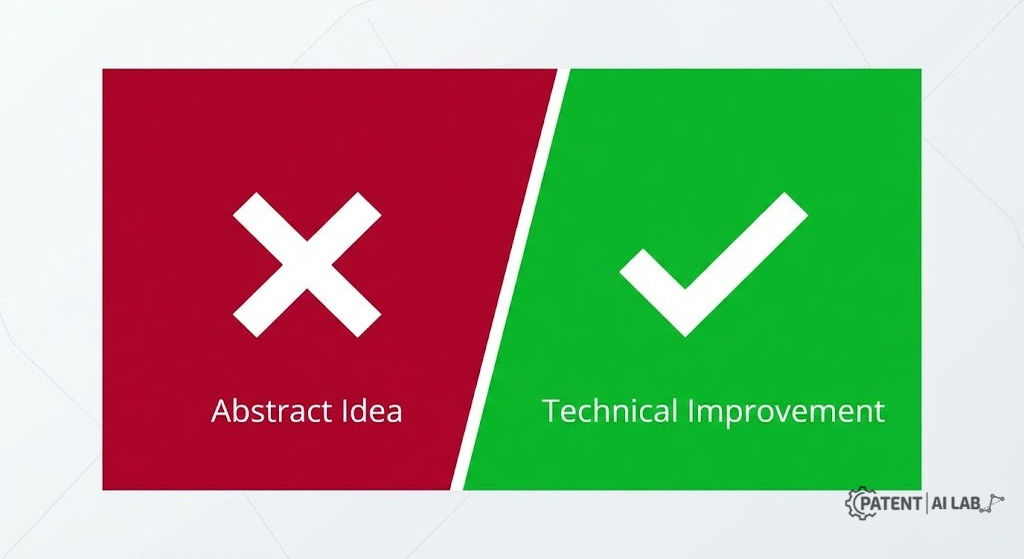
Eligibility Matrix: Abstract vs. Technical
Technical Improvement Argument: How to Make It Stick
A winning Alice test step 2 analysis answers three questions clearly:
What technical problem existed?
How did prior systems fail?
How does your AI solution change system operation?
AI-Generated Code and Patent Eligibility
AI-generated code is not automatically unpatentable. The USPTO cares about who conceived the invention, not who typed the code.
Human identification of the technical problem
Human selection of the solution
Human-directed application
Intellectual Property Protection for Software Startups
They signal poor technical depth to competitors and investors alike.
Future Outlook: Where AI Patent Eligibility Is Heading
- Section 101 remains strict
- Examiner scrutiny increases for generic AI
- Strong system-level AI patents continue to issue
- ▹Possible legislative reform
- ▹More industry-specific AI patents
- ▹Greater emphasis on hardware-software integration
Podcast
This automated audio brief outlines the primary data, analysis, and strategic insights covered in this guide.
FAQs
Can AI algorithms be patented in the US?
Yes, if they are claimed as part of a practical application that produces a technical improvement. Pure algorithms are not patentable.
What is the biggest reason AI patents get rejected under Section 101?
Claims that focus on data processing or predictions without tying them to system-level improvements.
Does using machine learning automatically trigger Alice?
Often yes, but Alice step 2 can be satisfied with proper claim drafting.
Can AI-generated inventions be patented?
Yes, if a human directed and conceived the invention. AI cannot be an inventor, but it can be a tool.
Should startups file AI patents early?
Yes, but only if they can clearly articulate technical improvements. Filing weak AI patents wastes money.
Sources and Legal References
The eligibility standards and legal frameworks analyzed in this article are derived from established federal statutes, official administrative updates, and binding judicial precedents regarding software and algorithmic patents:
-
1. 35 U.S.C. § 101 (Inventions Patentable)
The foundational federal statute defining eligible subject matter for patent protection, excluding abstract ideas, natural phenomena, and laws of nature.
Review USPTO Section 101 Guidelines -
2. Alice Corp. v. CLS Bank International (Supreme Court, 2014)
The landmark Supreme Court decision establishing the two-step framework for determining whether software and algorithm-based claims contain an eligible inventive concept.
Read the Supreme Court Opinion (PDF) -
3. USPTO 2024 Guidance Update on Patent Subject Matter Eligibility (89 FR 58128)
The official federal register mandate specifically clarifying practical application boundaries, examiner criteria, and technical alignment requirements for AI and machine learning inventions through 2026.
Verify Federal Register AI Guidance
Disclaimer & Legal Notice
PatentAILab is an independent educational research platform and is not a licensed law firm or financial advisory service. The data, patent analysis, and strategic insights provided in this article are for informational and educational purposes only and do not constitute legal, investment, or business advice. Intellectual property outcomes depend on specific technical facts, jurisdictional laws, and drafting execution. Always consult a certified patent attorney and a qualified financial advisor before making IP filing or venture capital investment decisions.




[…] Most people are still arguing the wrong side of this issue (Copyright vs Patent), while smart teams are focusing on Conception. To understand how these exact rules apply to backend logic and math, read our complete breakdown on Can You Patent an Algorithm? A Simple Guide to AI & Section 101. […]
[…] One strong US patent on a foundational transformer architecture is worth more than 500 minor application patents. US patents define how the AI thinks. Chinese patents define where the AI is used. Unsure if your code qualifies? Read our simple guide on Can You Patent an Algorithm in 2026? […]