


 Golam Rabiul Alam, PhD
Editorial note: This article evaluates commercial IP software and USPTO examination trends for informational purposes only. It is not legal advice. See disclaimer below.
Undocumented human conception in an AI-assisted invention is a real vulnerability, not a hypothetical one. On November 28, 2025, the USPTO’s Revised Inventorship Guidance for AI-Assisted Inventions rescinded the confused 2024 framework and replaced it with a stricter baseline: AI is a tool, not a collaborator. Under the new USPTO AI Patent Rules 2026, an application that cannot show a natural person conceived the claimed invention is at serious risk of rejection or later invalidation. What follows is a breakdown of the new standard, why the Pannu factors no longer apply to single-inventor cases, and the kind of documentation record that tends to hold up once an examiner starts asking questions.
At A Glance: AI Inventorship in 2026
In 2026, the landscape for patenting AI-assisted inventions centers on a definitive legal baseline: AI is a sophisticated tool, but the inventor must be human. To secure patent rights, applicants must show that a natural person passed the traditional conception test.
The 2026 Legal Framework
- The Rescission: The February 2024 guidance is officially withdrawn.
- The Tool Standard: AI systems are legally analogous to laboratory equipment or research databases. They cannot conceive inventions.
- The Pannu Correction: The Pannu joint-inventorship factors no longer apply to AI. They strictly govern collaborations between multiple human beings.
A U.S. priority claim to a foreign application that names an AI tool as the sole inventor will be rejected by the USPTO, per Section VI of the revised guidance.
Key Takeaways
The five points below aren’t just a checklist — each one maps to a specific place where an inventorship dispute actually gets decided, whether that’s at the examiner’s desk during prosecution or years later in litigation, once the underlying project records are harder to reconstruct.
- The Legal Rule: AI is a tool, not an inventor. Under U.S. patent law, only natural persons can be inventors, a precedent firmly established by Thaler v. Vidal, 43 F.4th 1207 (Fed. Cir. 2022). That ruling didn’t leave room for degrees of AI autonomy to matter; the court looked at the statutory word “individual” and read it as unambiguously human, full stop, regardless of how sophisticated the underlying system was.
- The 2026 Standard: The revised USPTO guidance controls the prosecution process. The inquiry centers strictly on whether the human contribution amounts to conception, defined as a specific, settled solution to a problem, not a request or a research goal handed to an AI system.
- Pannu Factors Role: The Pannu joint-inventorship analysis is used exclusively to determine which humans on a team qualify as joint inventors when AI is involved. The factors say nothing about whether the AI itself contributed, because that question doesn’t arise under the current guidance — an AI system isn’t a natural person, so there’s no joint-inventorship question to ask about it in the first place.
- Evidence Matters: The strongest defense against an inventorship challenge is a “Conception Map”: prompt logs, version-control history, and technical edits that trace each claim limitation back to a specific human decision, not just a general assertion that a person was “involved” in the project somewhere along the way.
- Drafting Strategy: To survive Section 101 scrutiny, claims should describe a concrete technical improvement, not a generic invocation of “using AI to analyze data” — the difference between those two framings is often the difference between allowance and rejection, and it comes down to specificity rather than the underlying technology itself.
Using AI Is Legal Under the USPTO AI Patent Rules 2026
The era of regulatory ambiguity ended in late 2025. Today, deploying generative AI models (GPT-5, Claude, or internal coding copilots) is treated legally the same as utilizing CAD software or a research database — the USPTO does not penalize the use of these tools, and nothing in the revised guidance asks applicants to disclose which AI system assisted a project. However, the human-contribution requirement imposes a rigid boundary that no amount of tool sophistication changes: the AI cannot conceive the invention. The operational question that actually matters for prosecution is no longer “Can I use AI?” but rather “Who actually invented the specific claim limitations?” That reframing is where most of the practical risk in this area lives, because it shifts the burden from justifying tool use to documenting human judgment, and it’s a shift that changes what kind of records a team needs to be keeping from the very start of a project rather than after a disclosure is drafted.
How the Guidance Changed from 2024 to 2026
For legal teams and technical founders, understanding this timeline matters for a practical reason: applications drafted under the 2024 approach may have been built around an analytical framework — evaluating AI contribution directly — that the active USPTO AI Patent Rules 2026 explicitly reject. The shift changes what evidence an examiner looks for during prosecution.
- February 13, 2024: The USPTO issued its initial AI inventorship guidance, adapting the Pannu v. Iolab Corp. (1998) factors — originally designed to assess joint inventorship between multiple humans — to evaluate whether a human’s contribution to an AI-assisted invention was “significant” enough. Critics argued this approach overcomplicated a straightforward question by importing a multi-person test into single-inventor scenarios, adding a layer of analysis the statute itself never required. (Now Fully Rescinded).
- November 28, 2025: The USPTO published the Revised Inventorship Guidance for AI-Assisted Inventions, effective immediately upon publication (Federal Register Vol. 90, No. 227, pp. 54636–54637, Docket No. PTO-P-2025-0014). This document fully rescinded the 2024 framework and, notably, withdrew Pannu analysis entirely for single-inventor cases rather than refining it, per the guidance’s own Section II.
- 2026 Practice: Current examination adheres strictly to the 2025 revised rules. The focus is entirely on traditional human conception, applied the same way it would be applied to an invention that involved no AI at all — the guidance’s Section III is explicit that there is no separate or modified standard for AI-assisted inventions.
Why Thaler v. Vidal Still Blocks AI From Being an Inventor
The bedrock of current USPTO policy remains the Federal Circuit’s decision in Thaler v. Vidal, 43 F.4th 1207 (Fed. Cir. 2022). The court ruled that the Patent Act defines an “inventor” as an “individual,” and that “individual” as used in the statute means a natural person — a reading the court reached by looking at the Act’s use of personal pronouns like “himself” and “herself,” which it noted would be an odd drafting choice if Congress meant to include machines. This ruling means that regardless of how autonomous an AI system appears, it holds no legal standing for intellectual property rights, and an invention generated solely by an AI model with no substantive human contribution is not eligible for patent protection. The revised 2025 guidance leans on this holding directly rather than reinterpreting it, citing Thaler as settled authority in its own Section III discussion of governing legal standards.
Decoding the “Significant Contribution” Test for Patents
The phrase “significant contribution” functions as shorthand for a specific legal mandate: an inventor must contribute directly to the conception of the claimed invention, not merely supervise or verify what a tool produced.
Defining “Conception” in the AI Era
Conception is the formation in the mind of the inventor of a “definite and permanent idea” of the complete and operative invention. The distinction the USPTO draws here is concrete enough to apply in practice, not just in theory:
- Not Conception: “I want an AI model that predicts weather better.” (This is merely a research goal).
- Conception: “I want a weather model that uses a specific attention mechanism on humidity tensors to reduce latency by 20%.” (This is a definitive, technical solution).
The difference between those two statements is the entire test. To satisfy USPTO scrutiny on this point, documentation should show that the human operator moved beyond the goal phase and explicitly defined the solution framework, even if the AI assisted in drafting the execution code afterward. An examiner reading a disclosure is essentially asking which of those two sentences describes what actually happened before the AI was engaged, and that question tends to be answerable only if the underlying project records were kept contemporaneously rather than reconstructed from memory once the application was already being drafted.
The Pannu Factors for AI Inventions: A Misunderstood Tool
The most common misconception in this area involves misapplying the Pannu factors to the AI itself, rather than to the humans involved. The 2025 guidance draws a sharp line here: if one human uses AI, the Pannu factors are entirely irrelevant, and the test is simply whether that single person conceived the invention. If a team uses AI, the Pannu factors are deployed strictly to evaluate the contributions among the human team members — the AI’s involvement doesn’t enter that analysis at all, because an AI system isn’t a person and so raises no joint-inventorship question in the first place. That last point is worth sitting with, because it’s the specific correction the 2025 guidance makes to the 2024 approach: not a refinement of how Pannu applies to AI, but a wholesale removal of AI from the Pannu analysis entirely.
The Pannu Factors dictate that a joint inventor must:
- Contribute in a significant manner to the conception or reduction to practice.
- Make a contribution that is not insignificant in quality relative to the full invention.
- Do more than merely explain well-known concepts or the current state of the art to the real inventors.
The 2026 Correction: Pannu does not apply to the AI model itself. It applies to the human engineers, to establish that they executed inventive judgment rather than merely prompting the system with basic instructions.
The Mental Model: Human Decisions vs. AI Suggestions
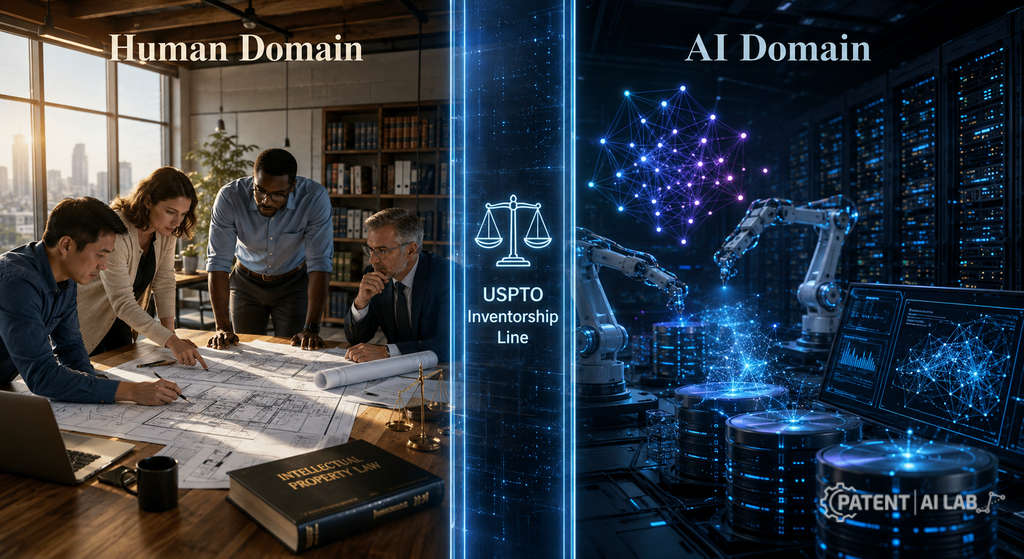
Assessing whether a specific human-AI project can be patented often comes down to a simple boundary test. The left column below is where inventorship lives; the right column is where the AI operated as a tool, however useful its output was:
| Human Domain (Inventorship) | AI Domain (Tool Use) |
|---|---|
| Selecting specific algorithmic architecture or data representation | Brainstorming broad lists of potential ideas |
| Defining strict parameter constraints (e.g., “Max latency 50ms”) | Generating generic boilerplate code structures |
| Designing control logic to achieve a measurable technical effect | Providing alternative options that the human rejects |
| Interpreting outputs and modifying the system based on insight | Processing data inputs or hallucinating citations |
If an engineering team cannot pinpoint a human who actively made the decisions in the left column, the patent application is likely to face inventorship challenges, and those challenges tend to surface at the worst possible time: during litigation, when the underlying conception evidence may be years stale and the people involved may no longer remember the specifics well enough to reconstruct a credible account.
5 Steps to Pass the USPTO’s “Significant Contribution” Test in 2026
Securing durable IP rights over an AI-assisted invention works best as a proactive compliance protocol rather than a retrofitted explanation. Retrofitting inventorship claims after the fact is a legal hazard, largely because contemporaneous records are much harder to fabricate convincingly than a narrative constructed after the fact — examiners and courts both tend to notice the difference, whether through inconsistencies in dates, gaps in version history, or simply a level of technical detail that reads as reconstructed rather than lived. For anyone in this position, these five steps are worth building into the R&D phase itself, not bolted on afterward once a filing deadline is already approaching.
Step 1: Lock the Human Problem Framing Before Prompting
A common and costly operational error is diving straight into ChatGPT or Copilot without establishing a baseline first. Doing more than commanding the AI to build “something cool” is the threshold that matters here, and it’s a threshold that has to be cleared before the first prompt is written, not reconstructed afterward from memory. A dated, version-controlled document (e.g., INV-001_InventionFrame.md) is one practical way to establish that baseline, and should outline three things:
- The Technical Problem: (e.g., “Memory footprint of LLMs on edge devices is too high.”)
- Strict Constraints: (e.g., “Must execute on under 8GB RAM while maintaining 95% baseline accuracy.”)
- The Human Hypothesis: (e.g., “We believe replacing the traditional attention layer with a state-space model will satisfy these constraints.”)
This kind of documentation helps verify that conception originated with the human prior to engaging the AI model — the date stamp and the version history do real evidentiary work here, since they establish a timeline an examiner or opposing counsel can’t easily dispute. Before the initial prompt, confirming that the hypothesis is actually novel is a useful early check; a search of the existing landscape at this stage can save considerable rework later if a similar approach already exists in prior art.
Step 2: Turn AI Sessions into Controlled Experiments
Treating prompt engineering as a documented laboratory experiment, rather than a black box, is the more defensible approach, and it maps onto a protocol with two working parts.
The Protocol:
- Structured Prompts: Prompts that enforce specific technical constraints designed by the human operator.
- The Log: An immutable log of every major AI interaction, covering:
- Prompt Text: What exact parameters were requested?
- Model Version: Which specific AI architecture was used?
- Human Annotation: Was the output accepted as-is? Was it explicitly modified, and why?
This audit trail is what demonstrates that the human maintained intellectual control over the tool throughout the process, rather than simply accepting whatever the model produced without meaningful scrutiny.
Step 3: Capture “Conception Moments” With a Conception Map
A structured Conception Map is one of the stronger evidentiary tools available for documenting human authorship. This matrix links every claim limitation to a verifiable human decision, and its value is in the specificity — a vague assertion that “the team was heavily involved” carries little weight, while a table row tying a specific claim element to a specific memo, dated and attributable to a named person, does real work in an inventorship dispute.
| Claim Limitation | Human Decision (The “Why”) | Evidence Link | AI Role |
|---|---|---|---|
| “Encoder uses quantized embeddings” | CTO mandated quantization to satisfy the 8GB RAM constraint established in Step 1. | Design Memo #4 | AI suggested standard dense embeddings; expressly rejected by human operator. |
| “Anomaly threshold via conformal score” | Lead Engineer engineered the scoring math specifically to eliminate false positive rates. | Jupyter Notebook Log | AI drafted the basic helper function to execute the human’s math. |
| “Privacy filter removing PII” | Product Owner defined the strict PII parameters based on GDPR compliance. | Product Spec Doc | AI generated the functional Regex pattern. |
This kind of table is what neutralizes examiner skepticism about whether the human contribution was substantive or cosmetic — it converts a claim of involvement into a traceable, checkable record.
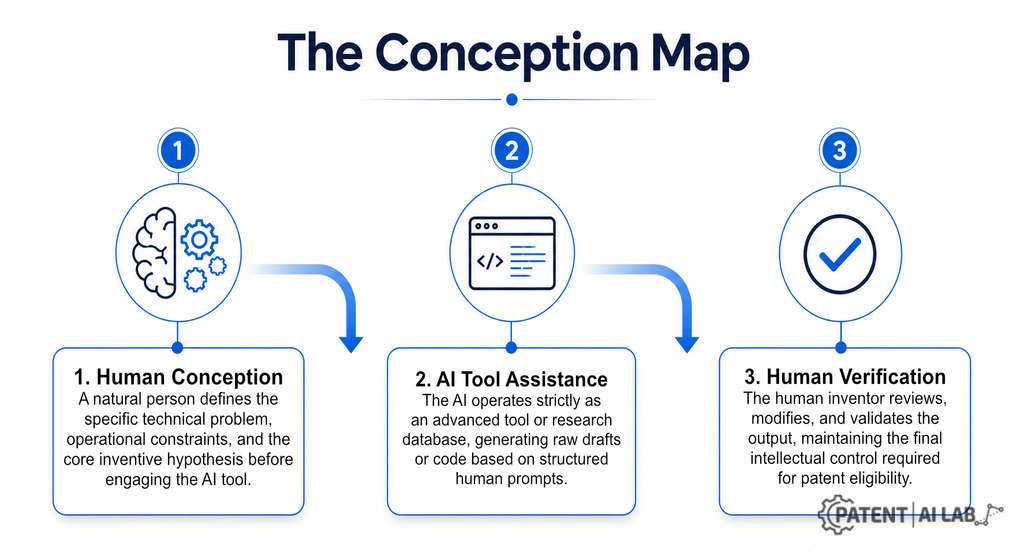
Step 4: Separate AI-Generated Drafting from Human Drafting
When patenting AI-generated code, distinct authorship tracking closes what would otherwise be a “black box” credibility gap — the concern an examiner or opposing litigator raises when a codebase shows no visible seam between what a model produced and what a human actually decided.
Practical Engineering Workflow:
- Sandbox: Isolate all raw AI outputs in a dedicated directory (e.g., /scratch/ai_drafts/).
- Human Integration: Push code to production exclusively via a human-reviewed Pull Request (PR).
- The Certification Checklist: The human developer certifies in the PR:
- “I comprehend this logic and can independently explain its execution.”
- “I actively modified the AI draft to conform to our proprietary architecture.”
- “I deployed tests to empirically verify the claimed technical effect.”
Real-World Code Audit: AI vs. Human Contribution
❌ 1. AI Draft (Generic Baseline: Unpatentable)
def rank(query_vec, doc_vecs):
    # Standard cosine similarity (Abstract Math)
    scores = doc_vecs @ query_vec
    return scores.argsort()[::-1]
✅ 2. Human-Edited Version (Patentable Technical Improvement)
Human contribution: Injected specific quantization for memory constraints and fairness logic.
def rank(query_vec, doc_vecs, temp: float, group_ids):
    q = quantize(query_vec)              # Human Constraint: On-device memory
    D = quantize_matrix(doc_vecs)
    raw = (D @ q) / max(temp, 1e-6)      # Human Constraint: Temp scaling
    scores = apply_group_fairness(raw, group_ids)  # Human Logic: Fairness compliance
    return scores.argsort()[::-1]
The gap between these two snippets is the entire argument for inventorship in miniature. The first version is textbook cosine similarity — the kind of thing found in any introductory information-retrieval course, with no fingerprint of a specific human decision anywhere in it. The second version encodes three separate constraint decisions (memory quantization, temperature scaling, fairness enforcement) that trace directly back to problems a human defined before any AI was involved. An examiner comparing the two isn’t just looking at code style; they’re looking for exactly this kind of traceable decision history, which is also why the Conception Map from Step 3 and this code comparison work best as companion pieces of evidence rather than standing alone.
Step 5: Run an Inventorship Audit Before Filing
Prior to USPTO submission, a final audit is worth running to confirm that the documentation built up over Steps 1 through 4 actually holds together as a coherent inventorship record, rather than assuming it does simply because each step was followed individually.
The Pre-Filing Checklist:
- [ ] Zero AI systems are listed as inventors (Natural persons only).
- [ ] Every named human can articulate their contribution to a defined claim limitation.
- [ ] If multiple humans are listed, the Pannu factors have been applied to verify their joint status.
- [ ] Priority Audit: If claiming priority to a foreign application, confirm that the foreign filing did not list an AI tool as the sole inventor. Per Section VI of the revised guidance, the USPTO will not accept the priority claim if this occurs.
Once that audit confirms human inventorship is well-documented, locking in a priority date is the natural next step. A separate guide on this site walks through the mechanics of filing a provisional patent without an attorney, for readers who want that background. It covers the DIY filing process only; it is not a substitute for retaining a registered patent attorney or agent, particularly once inventorship questions or an office action are involved.
Drafting Patent Claims for AI Inventions: The §101 Hurdle
Inventorship is only the first checkpoint. Subject Matter Eligibility under Section 101 is the next execution barrier, and in 2026 the USPTO closely scrutinizes AI claims for “abstract ideas” using the Alice/Mayo framework the agency applies across all computer-implemented inventions, not just AI-specific ones.
Technical Improvement vs. Abstract Idea
To secure allowance, claims need to architect a definitive technical improvement rather than describe an outcome in business terms. The contrast below illustrates the gap examiners are trained to look for:
- Fatal Claim: “A system utilizing AI to analyze customer data and predict churn.” (Likely an Abstract Idea Rejection — this describes what the system accomplishes, not how it does so technically).
- Viable Claim: “A neural network architecture utilizing a dynamic sparsity mask to reduce inference latency by 40% on edge processors.” (A Concrete Technical Improvement — this names a specific mechanism and a measurable effect).
Drafting Guidance: Claims are stronger when they describe exactly how the AI model improves the physical functioning of the computer hardware (speed, memory retention, cryptographic security), rather than merely claiming the automation of a business process. The first claim above could describe almost any churn-prediction product on the market; the second could only describe one specific technical approach, which is precisely the specificity Section 101 analysis rewards, and it’s a distinction worth checking against every independent claim in a draft before filing, not just the headline claim.
Global Perspective: US vs UK AI Patent Laws
Founders routinely conflate the legal standards across jurisdictions, which can lead to costly international filing errors, particularly because the US and UK diverge in one specific area (copyright) while agreeing completely in another (patents).
United States:
- Inventorship: Requires a natural person (Thaler v. Vidal).
- Copyright: Prohibits copyright assignment for entirely AI-generated works.
United Kingdom:
- Inventorship: Requires a natural person (affirmed by the Supreme Court DABUS ruling).
- Copyright: The UK maintains a distinct “computer-generated works” provision (CDPA 1988) where the legal “author” is the individual who made the operational arrangements.
- The Strategic Distinction: The UK’s flexibility is limited to copyright law, not patent inventorship. For patents, both the US and UK demand explicit human conception — a founder assuming that the UK’s more permissive copyright stance extends to patents would be filing on a mistaken premise.
Comparison Table: 2024 vs 2026 Guidance
| Metric | February 2024 Approach | 2026 Reality (Revised Nov 2025) |
|---|---|---|
| Legal Status | Fully Rescinded | Active and Controlling |
| Analysis Focus | Heavy emphasis on evaluating the “AI vs. Human” contribution split. | Strict emphasis on Human Conception under traditional standards. |
| Pannu Factors | Applied to AI systems in a way that drew criticism. | Clarified: Applies exclusively to human-to-human joint inventors. |
| Priority Risk | Ambiguous. | Foreign filings listing AI as sole inventor will be rejected in the US. |
Conclusion & Future Outlook
The landscape for AI-assisted patent applications in 2026 rewards rigorous process over unverified technical claims. The USPTO has outlined a clear path: use AI as a tool, but document the human mind as the ultimate source of conception. That documentation burden falls entirely on the applicant, and the guidance gives no indication it will loosen as AI tools become more capable — if anything, the opposite seems more likely as scrutiny of AI-assisted filings increases across the industry.
Future Outlook (2026–2028):
- Tooling: Expect continued growth in “Invention Lab” style software designed to log prompts and track code diffs for patent compliance purposes. Comprehensive documentation matters not just for initial filing, but for surviving prosecution and, later, litigation, where the same records may need to hold up under cross-examination years after the fact. A related piece on this site covers the automation tools relevant to defending claims once an office action arrives.
- Litigation: Corporate disputes are likely to shift from arguing “Can AI invent?” toward forensic disagreements over “Who explicitly engineered the prompts?”, including in founder equity litigation where inventorship credit has direct financial stakes.
- Policy: Watching for updates to reduction-to-practice rules is worthwhile, particularly as AI agents gain the capability to execute laboratory experiments with less direct human oversight — a scenario the current guidance doesn’t fully anticipate.
The practical takeaway: frame the technical problem as a human first, log the experimental journey as it happens rather than reconstructing it later, and verify the output systematically. Each of those three habits maps to one of the five steps above, and together they’re what separates a defensible inventorship record from a narrative built after the fact.
Podcast
Note: This audio is a condensed intelligence brief. Please review the detailed matrices above for granular legal frameworks and prompt-logging protocols.
FAQs
Can human-AI collaboration be patented?
Yes, human-AI collaboration can secure patent protection in 2026, provided that a natural person explicitly contributed the conception of the invention. The USPTO treats the AI model strictly as a research tool that assisted the human inventor.
What is the “Significant Contribution” test for patents?
It is the operational standard utilized to ascertain if a human’s involvement satisfies the legal threshold for inventorship. The human must contribute directly to the “definite and permanent idea” of the invention (conception), rather than merely supplying a high-level goal or passively verifying an AI output.
How do Pannu factors apply to AI inventions?
Under the 2026 USPTO guidance, Pannu factors do not apply to the AI itself. They are deployed exclusively to determine which specific humans on a collaborative team qualify as joint inventors. If a human team uses AI, the Pannu framework isolates which team members provided the necessary significant contribution to conception.
Do I need to disclose AI use to the USPTO?
The USPTO mandates that there is no new, specialized duty to explicitly disclose AI use solely because an AI tool was deployed. However, applicants remain bound by the standard duty of candor; you cannot list an AI as an inventor, nor can you obfuscate AI generation if it directly impacts the legitimacy of the human inventorship claim.
Can I patent a prompt?
Generally, no. A prompt operates as a request or a generic goal, not a defined invention. However, if the prompt executes a novel prompt engineering method (i.e., a highly specific algorithmic architecture for querying a model to extract a distinct technical result), the operational method may be patentable, though the raw text string itself is not.
Sources and Legal References
The federal examination parameters, historical guidance rescissions, and joint-inventorship frameworks analyzed in this intelligence brief are sourced directly from the following primary legal directives:
-
1. Revised Inventorship Guidance for AI-Assisted Inventions
The primary Federal Register notice rescinding the 2024 guidance, withdrawing the Pannu factors for single-inventor AI-assisted cases, and re-establishing traditional human conception as the controlling standard. Federal Register Vol. 90, No. 227, pp. 54636–54637 (Nov. 28, 2025); Docket No. PTO-P-2025-0014.
Review Federal Register Notice -
2. Thaler v. Vidal, 43 F.4th 1207 (Fed. Cir. 2022)
The foundational Federal Circuit decision ruling that the Patent Act defines an “inventor” as a natural person, barring AI systems from holding intellectual property rights. Primary opinion available directly from the court.
Review Federal Circuit Opinion -
3. Foreign Priority Claims — Benefit/Priority Provisions
Section VI of the Revised Inventorship Guidance sets out the specific rule directly: a priority claim to a foreign application naming an AI tool as the sole inventor will not be accepted, and the requirement that at least one natural person be named in common applies across all benefit and priority claims under 35 U.S.C. 119, 120, 121, 365, and 386.
Review Section VI of the Federal Register Notice
Disclaimer & Legal Notice
This article reflects the author’s analytical perspective evaluating enterprise intellectual property strategy, federal inventorship standards, and USPTO examination frameworks. It is intended strictly for informational and strategic purposes and does not constitute formal legal advisory services. It is not a substitute for the counsel of a qualified, licensed intellectual property attorney. Patent eligibility standards, specifically regarding AI integration and Section 101, change frequently. Always consult certified legal counsel before defining inventorship claims or initiating patent prosecution.




[…] In practice, asking “Can AI code be patented?” is the wrong question. The better question is: “Is the human contribution around that code concrete, technical, and defensible?” If you are unsure how to prove this to an examiner, check out our detailed guide on Patenting AI Inventions. […]