


 Golam Rabiul Alam, PhD
At A Glance: Why You Should Care
The real Design patent cost in 2026 is far lower than most founders realize, making it the smartest entry point for anyone needing serious protection on a bootstrapper’s budget.
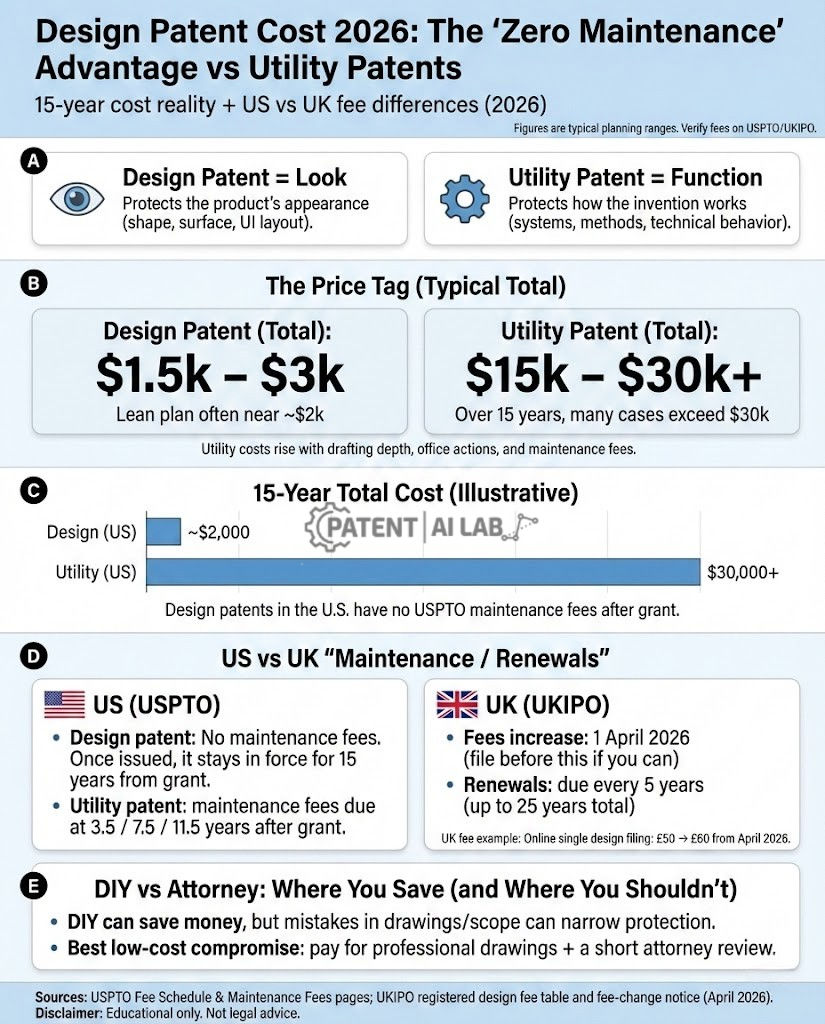
- 💰 The Price Tag: Unlike utility patents, which can cost $30,000+ over their lifetime, a design patent protects how your product looks for a fraction of that, typically $1.5k to $3k total.
- 🛡️ The “Zero Maintenance” Hack: Once granted, a U.S. design patent lasts 15 years. The best part? You pay zero maintenance fees to keep it alive.
The UK Warning:
If you are selling across the pond, watch out. Registered design cost UK fees increased on April 1, 2026, and unlike the US, they require payments every 5 years.
Key Takeaways
- The “Zero Maintenance” Advantage: Utility patents demand expensive upkeep payments at years 3.5, 7.5, and 11.5. U.S. design patents do not. Once you pay the issue fee, you own the rights for 15 years without paying another cent to the USPTO.
- Massive Cost Difference: A design patent typically costs $1.5k–$3k total to secure. A utility patent often exceeds $20k–$30k over its lifecycle when you factor in attorney fees and mandatory maintenance.
- The “Bridge” Strategy: Smart founders use design patents to get “Patent Pending” status cheaply on Day 1, validating the market before spending big money on utility patents later.
- UK Fee Update (2026): If you are filing in the UK, note that fees for registered designs increased on April 1, 2026.
- Look vs. Function: Design patents only protect the visual appearance (UI, shape, ornamentation). They do not protect the code, algorithm, or internal mechanics.
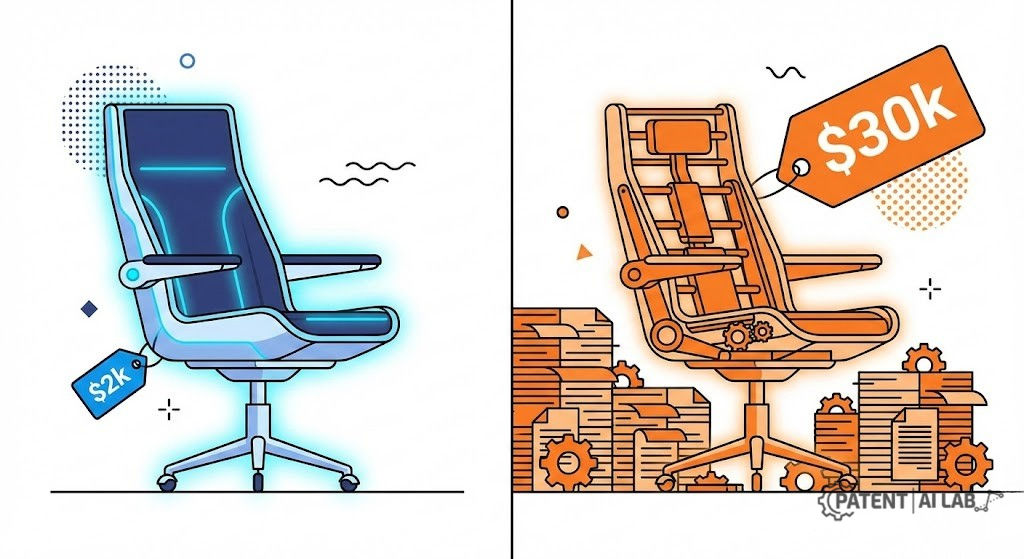
When you have a brilliant product idea, the excitement is usually followed by a cold dose of reality: the fear of legal bills.
Most founders picture intellectual property (IP) as a rich person’s game. They imagine a team of attorneys in high-rise offices handing them a bill that looks like a down payment on a house. Because of this fear, thousands of inventors launch their products “naked” (completely unprotected) assuming that because they can’t afford a $20,000 utility patent, they have no options at all.
That is a dangerous, expensive myth.
In 2026, the design patent cost landscape offers a massive financial “loophole” for bootstrappers. It provides you with federal IP protection, the legal right to slap “Patent Pending” on your packaging, and a 15-year monopoly on your product’s appearance, all without the recurring financial nightmare of maintenance fees.
This guide isn’t just a list of fees. It is a financial survival guide for inventors. We are going to break down exactly what you will pay, uncover where the hidden costs hide, and explain why the design patent vs utility patent cost gap is wider than ever this year.
The Price Tag: Design Patent (Look) vs. Utility Patent (Function)
To understand if you are getting a good deal, you first need to understand exactly what you are buying. Patent law is split into two main camps: how things work and how things look.
Think of it this way: Imagine you invent a new ergonomic office chair.
- Utility Patent: Protects the mechanical lever that adjusts the lumbar support and the specific way the mesh breathes. It protects the function.
- Design Patent: Protects the futuristic curve of the armrest and the specific visual pattern on the seat. It protects the appearance.
If your competitive advantage is “my product looks cooler and sleeker than the generic stuff on Amazon,” a design patent isn’t just the cheaper option; it is the stronger option.
Preliminary Cost Comparison (Typical Totals)
Here is the cold, hard reality of what leaves your bank account. These aren’t just USPTO fees; these are realistic totals including professional help to ensure you don’t mess it up.
| Protection Type | What it Covers | Typical Total Cost (Initial) | Ongoing USPTO Maintenance Fees? |
| Design Patent | Shape, configuration, surface ornamentation (The “Look”) | $1.5k – $3k | No (US Only) |
| Utility Patent | Method, system, device, process (The “Function”) | $15k – $30k+ | Yes (Due at 3.5, 7.5, 11.5 years) |
Note: These ranges are common for consumer products. If you are developing a complex medical device, costs go up. If you are designing a simple phone case, costs might be on the lower end.
2026 USPTO Design Patent Fee Schedule: The Breakdown
Let’s dig into the specific numbers. Following the major fee overhaul on January 19, 2025, the USPTO enforces a specific fee structure in 2026. Understanding this helps you budget so there are no nasty surprises in your mailbox.
The USPTO offers massive discounts if you are a “Small Entity” (most startups/individuals) or a “Micro Entity” (low-income individuals or those with very few prior filings).
Core Design Patent Fees (Official)
| Fee Component | Large Entity (Corporation) | Small Entity (Most Startups) | Micro Entity (Qualifying Individuals) |
| Basic Filing Fee | $300 | $120 | $60 |
| Design Search Fee | $300 | $120 | $60 |
| Design Examination Fee | $700 | $280 | $140 |
| Design Issue Fee | $1,300 | $520 | $260 |
| Total Official Fees | **$2,600** | $1,040 | $520 |
The Financial takeaway: If you qualify as a micro entity, you can essentially buy a 15-year federal monopoly on your design for just $520 in government fees. That is arguably the cheapest way to patent a product in the developed world.
Hidden Costs You Must Watch For
The table above covers the “Happy Path” where everything goes right. But in the legal world, things often get complicated. You might trigger extra costs if:
- Restriction Requirement: You try to include three different versions of your product in one application. The USPTO will force you to pick one or pay for separate filings.
- Drawing Corrections: If your drawings have blurry lines or incorrect shading (a common DIY mistake), the examiner will object. You will have to pay a draftsman to fix them and potentially pay a fee to submit the correction.
- Extension of Time: If you are late responding to a letter from the patent office, the fines pile up quickly.
The “Zero Maintenance” Advantage: Why It Matters
This is the section that many high-priced utility patent attorneys gloss over because it hurts their bottom line.
In the United States, the Design Patent is a No maintenance fee patent. This is the golden standard for low-maintenance IP portfolios. The USPTO is explicit: maintenance fees are not required for design patents.
Once you pay that “Issue Fee” listed in the table above, you are done. No more checks to the government. No more calendar alerts fearing your patent will expire because you forgot to pay an $800 invoice. You own the asset, free and clear, for 15 years.
Why Utility Patents Bleed Money (The Maintenance Trap)
Contrast this with utility patents. You might struggle and scrape to pay the $15,000 to get the utility patent granted, thinking the hard part is over.
It isn’t.
To keep a utility patent alive, you must pay Patent maintenance fees 2026 at three strict deadlines. If you miss them, your patent dies, and your invention enters the public domain.
Utility Patent Maintenance Fees (2026 Official Schedule)
| Deadline (Years from Grant) | Large Entity | Small Entity | Micro Entity |
| 3.5 Years | $2,150 | $860 | $430 |
| 7.5 Years | $4,040 | $1,616 | $808 |
| 11.5 Years | $8,280 | $3,312 | $1,656 |
The 15-Year Reality Check:
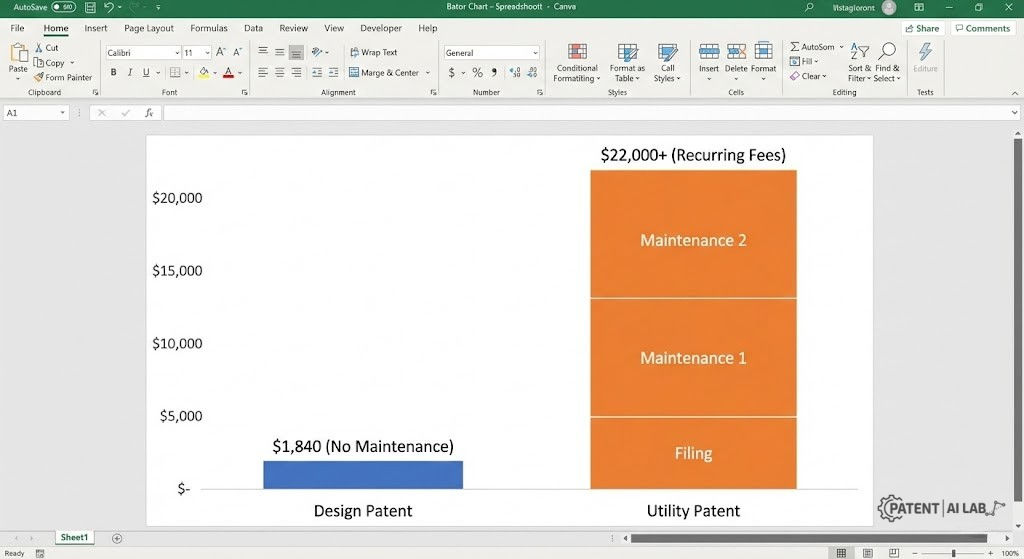
A small entity holding a utility patent for its full life will pay nearly $6,000 just in maintenance fees. That’s on top of the initial $15k-$30k legal bill. A design patent holder pays $0.
Total Lifecycle Cost Analysis: The 15-Year Chart
Founders often make the mistake of looking only at the “Filing Fee.” You need to look at the Total lifecycle cost of utility patent vs design patent. This is where the Design Patent shines as an investment vehicle.
Let’s model this out for a typical bootstrapper (Small Entity status) over a 15-year period.
✅ Scenario A: The Lean Design Patent
- Year 0 (Filing): $520 (Filing/Search/Exam fees) + $800 (Professional Drawings) + $0 (DIY filing) = $1,320
- Year 1.5 (Grant): $520 (Issue Fee)
- Years 3-15: $0
⚠️ Scenario B: The Typical Utility Patent
- Year 0 (Filing): $800 (USPTO fees) + $10,000 (Attorney Drafting) = $10,800
- Year 1-3 (Prosecution): $5,000 (Responding to Office Action rejections)
- Year 3 (Grant): $516 (Issue Fee)
- Years 3.5, 7.5, 11.5: $860, $1,616, $3,312 (Maintenance)
📈 15-Year Cost Visualization
Financial Insight: The money you save by choosing a design patent (approx. $20k) is capital you can use for marketing, buying inventory, or hiring your first employee. For a pre-revenue startup, that liquidity is infinitely more valuable than a broader utility patent that drains your cash flow.
The UK Scenario: Registered Design Cost UK & 2026 Fee Hike
If you are planning to sell in Europe, you likely need protection in the United Kingdom. The UK system is different from the US. They call it a “Registered Design,” and the rules are changing rapidly.
The UK Intellectual Property Office (UKIPO) has announced fee increases taking effect April 1, 2026.
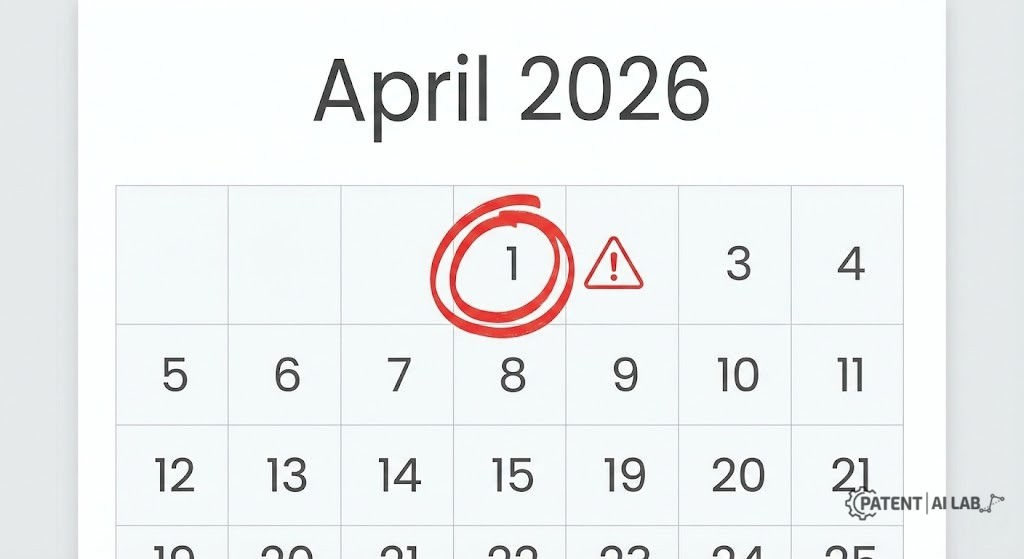
UKIPO Fee Changes (Effective April 2026)
The higher fee structure officially went into effect on April 1, 2026. Here is the updated pricing.
| UK Registered Design Fee Item | Previous Fee (Until March 31, 2026) | Current Fee (As of April 1, 2026) |
|---|---|---|
| Apply online (Single design) | £50 | £60 |
| Apply online (Up to 10 designs) | £70 | £85 |
| Deferred design request | £40 | £50 |
| 1st Renewal (Year 5) | £70 | £85 |
| 2nd Renewal (Year 10) | £90 | £110 |
The Renewal Difference: UK vs. US
Unlike the US “Zero Maintenance” system, the UK requires you to pay to keep your design.
- Frequency: Every 5 years.
- Max Term: 25 years.
So, while the initial Registered design cost UK is lower than the US (only £60!), the long-term cost creeps up because you have to keep paying every five years to maintain the monopoly. If you stop paying, your protection vanishes.
Startup Playbook: Design Patent Filing Cost for Startups
Knowing the costs is one thing; using them strategically is another. Here is a playbook I often recommend to cash-strapped founders who want to protect their invention without going broke.
The “Design First, Utility Later” Strategy
Many startups make the fatal mistake of trying to file a perfect utility patent on Day 1. They burn $15k, and then six months later, the market tells them their product needs to change. That $15k is gone forever.
A smarter approach:
- File a Design Patent ASAP: It’s cheap (~$1k-$2k). It gives you “Patent Pending” status immediately. It protects the visual look of your Version 1 product.
- Validate the Market: Spend the next 12 months selling. See if people actually want your product.
- File a Utility Provisional (Optional): If the function is truly unique, file a provisional utility application ($65 to $130 fees) to lock a date for the function.
If you decide to go this route, you don’t need expensive lawyers yet; you can follow our step-by-step guide on How to File a Provisional Patent Yourself for $65 to lock in your priority date cheaply. - Raise Prices / Funding: Once you have sales data, investors are more likely to write you a check.
- File the Non-Provisional Utility: Now that you have revenue or funding, you can actually afford the $15k+ for the utility patent.
Why this works: It minimizes your “at-risk” capital. You aren’t gambling $20k on an unproven idea. You are betting $2k to secure the asset, then scaling your spend only as the asset proves its value.
DIY vs. Attorney: Average Attorney Fees for Design Patents 2026
Can you do this yourself? Technically, yes. Should you? That depends on your risk tolerance.
Average Attorney Fees for Design Patents 2026:
- Big Law Firm: $3,000 – $5,000+
- Boutique IP Firm: $1,500 – $2,500
- DIY (You + Draftsman): $500 – $1,000
The Danger of DIY in Design Patents
In a utility patent, words matter most. In a design patent, drawings matter most.
If you file a design patent yourself with photos you took on your iPhone, or sketches that don’t meet strict USPTO standards (proper shading, broken lines, specific views), you will get rejected. Worse, you might get a patent that is practically useless because the scope is too narrow.
The “Hybrid” Sweet Spot for Bootstrappers:
This is the best way to keep your Design patent filing cost for startups under control while maintaining quality:
- Hire a Professional Draftsman: Spend $300-$500 to get professional patent drawings. Do not skimp here. This is the heart of your patent.
- File Yourself: If you are comfortable with government forms, you can file the application (Form ADS) yourself using those professional drawings.
- Attorney Review: Pay an attorney for 1 hour ($300-$500) just to review your filing packet before you hit submit.
This approach keeps costs low (under $1,000) while ensuring the critical part (the drawings) is professional.
Software & AI: What Does a Design Patent Actually Protect?
In 2026, software is everywhere. Founders often ask: “Can I design patent my app?”
Yes, but you need to be precise about what you are protecting.
AI-Generated Code Example: The Limitation
Let’s look at a snippet of React code for a dashboard widget.
function AnalyticsCard() {
  return (
    <div className="card">
      <header className="topbar">
        <h2>Weekly Anomaly Report</h2>
        <button className="filter">Filter</button>
      </header>
      <section className="grid">
        <div className="kpi">Latency</div>
        <div className="kpi">Errors</div>
        <div className="kpi">Cost</div>
      </section>
    </div>
  );
}
What a Design Patent Covers:
It protects the visual arrangement that this code renders on the screen. The rounded corners of the card, the specific placement of the “Filter” button relative to the “KPI” grid, and the ornamental style of the dashboard icons.
What it Does NOT Cover:
- The code itself (the text above).
- The function of “detecting anomalies.”
- The logic of how the filter works.
If your competitor writes totally different code but their app looks identical to yours, the design patent allows you to sue them. If their app looks totally different but functions the same way, the design patent is useless; you would need a utility patent for that.
When assessing Design patent cost 2026, remember that for SaaS companies, design patents are a cheap, effective way to stop copycats from cloning your User Interface (UI).
However, if your innovation is purely in the backend logic rather than the UI, a design patent won’t save you. In that case, you need to understand the nuances we covered in The Google vs Microsoft AI Patent Race to see how tech giants protect their algorithms.
The Verdict on 2026 IP Costs
If you take one thing away from this guide, let it be this: Don’t let the high cost of utility patents scare you away from protecting your IP entirely.
The Design patent cost 2026 landscape offers a massive opportunity for budget-conscious innovators. By utilizing the “Zero Maintenance” advantage of U.S. design patents, you can secure 15 years of protection for a total cost that is less than a single month of rent in many cities.
For those operating in the UK, keep your eye on the April 1, 2026 deadline to lock in lower rates, and remember to budget for those 5-year renewals.
Intellectual property is an asset. In 2026, you don’t need to be a millionaire to own it. You just need to be smart about which type of patent you choose. Start with design, secure your market, and build from there.
📚 Sources & References:
- USPTO Fee Schedule (Current; revised Jan 1, 2026).
- USPTO: “Maintain your patent” (maintenance fees not required for design patents).
- MPEP 1502: Definition of a design (look vs function).
- GOV.UK: New fees from 1 April 2026 (guidance + timing).
- GOV.UK: Registered designs fees table (old vs new).
- USPTO subject matter eligibility guidance hub + 2024 AI SME update.
Podcast
Disclaimer
This article is for general education and cost planning only. Patent fees and outcomes depend on your specific facts, entity status, and prosecution history. Please note that PatentAILab is an educational platform and not a law firm. This content is for educational purposes only and does not constitute legal advice. Intellectual property laws (especially regarding AI) are complex and change frequently. Always consult a qualified patent attorney for your specific situation.
Frequently Asked Questions (FAQs)
Here are the specific questions I hear most often about 2026 fees and costs.
What is the total design patent cost 2026 at the USPTO?
For a small entity (most startups), the total official USPTO fees are roughly $1,040 (Filing + Search + Exam + Issue). If you hire an attorney and professional illustrator, the total project cost usually lands between $2,000 and $3,500. For micro entities, official fees drop to about $520.
Do design patents have maintenance fees in the U.S.?
No. This is the No maintenance fee patent advantage. Once a U.S. design patent is granted, you do not pay any further fees to the USPTO to keep it active for its 15-year term.
What are patent maintenance fees 2026 for utility patents?
For utility patents, you must pay maintenance fees at three intervals. For a small entity in 2026, these are approximately:
3.5 years: $860
7.5 years: $1,616
11.5 years: $3,312
Large entities pay double these amounts.
Is a design patent the cheapest way to patent a product?
Yes, it is generally the cheapest way to patent a product to get “Patent Pending” status and an issued patent. However, it only protects the appearance. If your product’s value is entirely in its internal mechanism (and the outside looks generic), a cheap design patent might be a waste of money because it won’t stop competitors from copying the function.
What is the registered design cost UK in 2026?
As of April 1, 2026, the fee to apply online for a single design in the UK increased to £60 (up from £50). If you have multiple variations, you can file up to 10 designs for £85.
Do UK registered designs require renewals?
Yes, unlike the US system, UK registered designs must be renewed every 5 years. The fees start at £85 for the first renewal (year 5) and go up to £110 for later years. The maximum protection lasts 25 years.
Can I file a design patent myself (DIY) to save money?
You can, but design patents rely 100% on the quality of the drawings. A slight error in line type (solid vs. broken lines) can ruin your protection scope. It is highly recommended to at least pay a professional patent draftsman ($300-$500) to create the images, even if you fill out the forms yourself.



Add comment